
Executive Guide to Online Reputation Management (ORM)

Your brand isn’t what you say it is. It’s what Google says it is.
Imagine your business is a high-end storefront on the busiest street in the city. You spend millions on the interior, the product, and the staff. But outside, on the sidewalk, there is graffiti on your windows and a protestor standing at the door shouting at every customer who tries to enter.
Does it matter how good the inside is? No. The customers are already walking away.
In the digital world, Google Page 1 is that storefront.
If a potential client, investor, or employee searches for your name and finds negative reviews, misleading news, or—worse—nothing at all, you are losing revenue.
This is the definitive guide to Online Reputation Management (ORM). We will move beyond the myths of “deleting bad reviews” and explore the strategic framework of controlling your narrative, securing your digital assets, and insuring your brand against crises.
What Is Online Reputation Management? (It’s Not Just "Fixing Reviews")
Many people mistake ORM for “Review Management.” While responding to Google Business Profile reviews is part of the process, it is only a tiny fraction of the discipline.
Online Reputation Management (ORM) is the strategic practice of shaping public perception of an organization or individual by influencing online information.
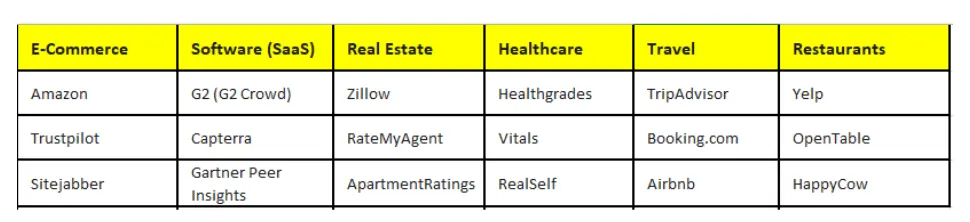
Strategic Platform Selection: Why One Size Does Not Fit All A common mistake in the industry is treating every business the same—focusing only on generic platforms like Google Maps or Facebook.
A strategic ORM approach requires “Niche-Specific” targeting. To get the maximum ROI (Return on Investment), you must focus your budget on the specific platforms where your stakeholders are actually looking.
- For Real Estate: 5 stars on Google doesn’t matter if there are 2 stars on Zillow or RateMyAgent.
- For Software (SaaS): Yelp is irrelevant, but G2 and Capterra are critical for buyer trust.
- For Healthcare: Patients bypass generic search results to look at Healthgrades and Vitals.
The goal is to identify the “High-Impact” channels for your specific industry and dominate them.
Think of it as Digital Asset Management.
- SEO is about ranking your website at the top.
- ORM is about controlling the entire first page of search results.
The goal isn’t just to hide the negative; it is to build a fortress of positive assets—news articles, social profiles, and owned content—that accurately reflect your brand’s authority.
Key Concept: You cannot always “delete” the internet. The solution to pollution is dilution. We build enough positive, authoritative content to suppress negative results to Page 2 or 3, where they become irrelevant.
Real-World Proof: The Michael Mahon (Corcoran) Case Study
You don’t have to take our word for it—you can verify the results yourself.
The Challenge: Michael Mahon, a prominent executive associated with Corcoran Global Living, faced a significant digital crisis. Serious allegations regarding fraud and financial mismanagement were dominating the top search results for his name. This damaged “digital storefront” was impacting business operations and personal reputation.
The Strategy: Since we could not simply “delete” the news reports, we deployed our Digital Real Estate Strategy. We constructed a network of high-authority assets to reclaim the first page of Google. We optimized profiles on trusted platforms like Crunchbase, LinkedIn, and RISMedia, and published strategic content to push the negative narratives off the front page.
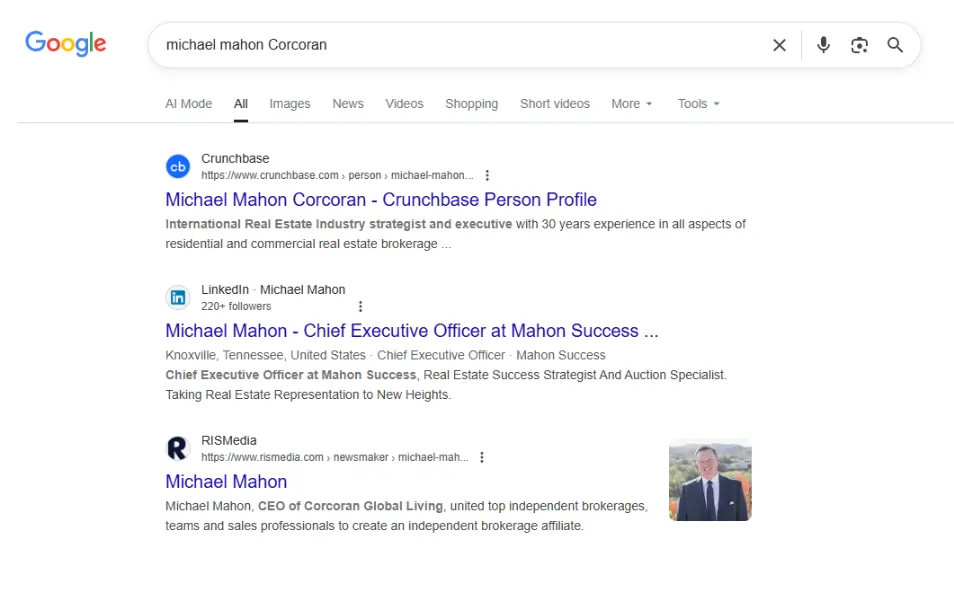
The Result (Verify it Yourself): Go to Google right now and search: “Michael Mahon Corcoran”.
Instead of scandal, you will see a controlled, professional narrative. As shown in the screenshot below, the top results are now dominated by:
- Crunchbase (Industry Profile)
- LinkedIn (Professional Network)
- RISMedia (Industry News Authority)
By securing these top 3 spots, we effectively rendered the negative news irrelevant for 95% of searchers. This is the power of suppression over removal.
Who Needs Reputation Management?
In the “Trust Economy,” reputation is currency. While every entity with a digital footprint needs to monitor their standing, three specific groups face the highest financial risk:
1. Corporations & Brands
A company’s market value is directly tied to trust. Negative sentiment affects stock prices, lowers customer lifetime value (LTV), and increases the cost of acquiring new customers. If your competitors have 4.8 stars and you have 3.5, you are paying a “reputation tax” on every ad you run.
2. C-Suite Executives & VIPs
Investors do not just vet the company; they vet the CEO. An executive’s personal reputation is now inseparable from the company’s brand. Negative press, old legal issues, or a lack of thought leadership content can derail funding rounds or mergers.
3. Small & Local Businesses
For local businesses (restaurants, medical practices, contractors), Google Maps is the lifeblood. A difference of one star can lead to a 5-9% difference in revenue.
The "Why": The High Cost of a Bad Reputation
Why invest in ORM? Because silence is expensive, and negativity is devastating.
- The “Zero-Click” Judgment: 90% of consumers read online reviews before visiting a business.
- The Revenue Hit: According to industry data, a business risks losing 22% of business when potential customers find just one negative article on the first page of search results. If there are three negative articles, that loss jumps to 59.2%.
- Recruitment Struggles: Top talent Googles you before applying. A bad reputation on Glassdoor or Indeed increases your hiring costs and lowers candidate quality.
The ORM Ecosystem: Which Channels Matter?
Your reputation lives in four distinct neighborhoods. We call this the PESO Model. To control your narrative, you must own real estate in all four.
- Paid Media: Ads and Sponsored Content. This gives you immediate control but stops working the moment you stop paying.
- Earned Media: Press coverage, news mentions, and third-party reviews. This is the most trusted source but the hardest to control.
- Shared Media: Social platforms (LinkedIn, X/Twitter, Facebook). This is where your community talks about you.
Owned Media: Your website, blog, and newsletters. This is your “Home Base”—the only channel you control 100%.
How to Control Your Reputation: The "Monitor, Repair, Build" Framework
You cannot control what people think, but you can control what they see. Successful ORM requires a three-phase strategy:
Phase 1: Monitor (Social Listening)
You cannot fix what you cannot see. We use advanced social listening tools to track brand mentions, sentiment shifts, and competitor attacks in real-time. This allows us to put out fires before they become infernos.
Phase 2: Repair (Response & Removal)
- Legitimate Negatives: We engage with unhappy customers to resolve issues and demonstrate high-class service.
- Illegitimate Negatives: We fight specific cases (violations of Terms of Service, fake reviews, defamation) to have content legally removed.
Phase 3: Build (Suppression Strategy)
This is the core of the “Digital Real Estate” strategy. We create high-quality, SEO-optimized content (press releases, guest blogs, video content) that floods the search results. By ranking these positive assets high, we push negative content down.
The Strategic Benefits of ORM
Investing in ORM is not an expense; it is an insurance policy for your brand equity.
- Higher Conversion Rates: Customers buy faster when they trust the reviews.
- Crisis Insulation: If you have a “bank” of positive goodwill, a minor PR scandal won’t destroy you.
- Lower Cost Per Acquisition (CPA): Good reviews do the selling for you, making your marketing budget work harder.
- Increased Valuation: For businesses looking to exit or raise funds, a pristine digital footprint increases the company’s perceived value.
Don't Leave Your Reputation to Chance
Your reputation is happening right now, whether you manage it or not. The internet does not forget, but it can be managed.
At DM YARANA, we don’t just “clean up” reviews. We build digital fortresses that protect your revenue and secure your legacy.
Comments
Search